
Le concours 2025-2026
L’ensemble des départements normands ont participé à cette édition 2025-2026.
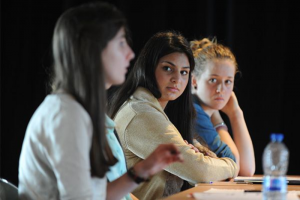
Dans le Calvados, la journée de qualifications des débats s’est déroulée le 7 avril dernier au collège Senghor de Ifs. Huit équipes venant du collège Hastings de Caen, du collège Langevin-Wallon de Blainville-sur-Orne, du collège Lottin de Laval d’Orbec, du collège Alphonse Allais d’Honfleur, du collège Maîtrise Notre-Dame de Douvres-la-Délivrande et du collège Senghor de Ifs se sont rencontrées et ont débattu sur les quatre sujets suivants :
- Homework deepens inequalities.
- School should focus more on building up life skills.
- AI can help educate.
- School is the best way to learn about culture.
Les élèves présents ont été enchantés par cette journée qu’ils ont trouvée motivante et stimulante. Il a été particulièrement intéressant pour les professeurs présents de voir les équipes progresser en tenant compte des conseils des jurys. Le respect mutuel dans les échanges et l’entraide entre les équipes ont également été particulièrement appréciés.
Les collèges Senghor, Hastings, Langevin-Wallon et Maîtrise Notre-Dame se sont qualifiés pour les demi-finales qui ont eu lieu à l’Hôtel du Département le 27 mai. Le sujet de la demi-finale était "Friendships shape you."
La finale a opposé le collège Senghor au collège Langevin-Wallon sur le thème "School is the best place to educate children". Le jury a désigné gagnante l’équipe du collège Langevin-Wallon de Blainville-sur-Orne.
Dans la Manche, ce sont également huit équipes qui se sont retrouvées le 29 mai dernier à la Maison du Département à Saint-Lô. Etaient représentés le collège Challemel Lacour d’Avranches, le collège Anne Heurgon-Desjardins de Cerisy-La-Salle, le collège Le Ferronay de Cherbourg-en-Cotentin, le collège Emile Zola de Cherbourg-en-Cotentin, le collège Saint-Paul de Cherbourg-en-Cotentin, le collège Jacques Prévert de Coutances, le collège Jules Barbey d’Aurevilly de Saint-Sauveur-Le-Vicomte et le collège Félix Buhot de Valognes.
Chaque équipe a pu débattre trois fois sur trois des quatre sujets suivants :
- Friendships shape you.
- School is the best way to learn about culture.
- School should focus more on building up life skills.
- Education shapes better citizens.
Les participants ont été jugés sur le respect des règles du débat, leur capacité à communiquer et à convaincre, leurs compétences langagières (la qualité de leur anglais) ainsi que sur la pertinence de leurs arguments, contre-arguments et exemples.
Les deux collèges premiers de leur poule se sont ensuite rencontrés en finale dans la salle des délibérations de la Maison du Département sur le thème : « Education shapes better citizens. » Les deux équipes ont défendu leur point de vue avec brio mais c’est finalement les élèves du Collège Le Ferronay de Cherbourg-en-Cotentin qui ont remporté la finale face aux élèves du collège Saint-Paul de Cherbourg-en-Cotentin.
Témoignages d’élèves
Collège Lottin de Laval – Orbec
Why did you decide to take part in this project ?
Hyrina : I took part in this project because I had seen a public speaking contest before. I thought that the way people were expressing themselves and their ideas was very dynamic, with various intonations. Debating isn’t exactly the same but I thought it could be a start and I wanted to practice my speaking skills.
Nina : I decided to participate at this project because I think its a great opportunity to improve my English with other poeples who have the same level as me.
How did you prepare for this project for the debates ?
Hyrina : a part of the preparation for the debates was in English + class during lunch breaks. We practised thinking about arguments (for or against) and it was really hard at first because we had never done that before. I also prepared myself at home by reading a few debates on internet forums and by talking to myself.
Nina : I prepared this project by practicing different debate topics with my English + group. We tried to organize ourselves to find arguments and vary our vocabulary.
Romane : to prepare for the debate, I prepared my arguments and I practised speaking English to feel more confident.
What did you think of the qualifying rounds/semi-final/final ?
Hyrina : I thought that qualifications weren’t always clear. Sometimes it was definitely sure that the opponents were better but sometimes when the levels were basically the same, the jury didn’t have a clear opinion about the assessment or what we should do to improve for the next debate. But I still loved to debate and meeting others students.
Alice : I think we worked very well because we did better from one debate to the next, even considering the high level of the other teams.
Romane : I found the debate and the qualification rounds very interesting and rewarding. Even if I was sometimes stressed, I enjoyed the atmosphere and the opportunity to exchange ideas with the other participants.
What did you learn about this experience ?
Hyrina : I learnt how to think quickly about an argument to answer to the other teams. I also learnt how to debate together as a team even if we didn’t have an amazing English, we managed to keep up and even won a debate. I think team work was really the most important thing I learnt on that day, and also having fun.
Alice : I learnt a lot about education and gained confidence in myself even when I am wrong.
Nina : I learnt to listen to other people and how to give arguments during a debate.
Romane : This experience taught me how to speak better in public, work with others, defend my opinions with good arguments and be more confident.
Collège Alphonse Allais (Honfleur)
Why did you take part in this project ?
Noémie : I took part in this project because I wanted to improve my English, become more confident when speaking, and meet other people who love English as well.
How did you prepare for the debates ?
Noémie : I always prepared for the debates with my team. We decided who would speak first and thought about our strategies. Communication is the key to good teamwork.
What did you think of the qualifying rounds ?
Noémie : I enjoyed them, but the only problem was that the judges did not always agree on the assessment criteria. My team was penalised because we spoke French when we prepared our conclusion. However, this had not been a problem in our previous debates. After the debate, we talked to students from other teams and found out that they had not been penalised for speaking French. We felt that this was unfair !
What did you learn from this experience ?
Noémie : I learned that I should not be afraid of making mistakes and should just keep going because that is how I will become more fluent and confident in English.
Collège Barbey d’Aurevilly (Saint-Sauveur-le-Vicomte)
Collège Le Ferronnay (Cherbourg-en-Cotentin)
On Friday, May 29th, we participated in the contest of the English citizens’ debates at the Maison du Département at Saint-Lô. There were eight middle schools taking part in the event : collège Challemel Lacour (Avranches), collège Anne Heurgon-Desjardins (Cerisy-La-Salle), collège Le Ferronay (Cherbourg-en-Cotentin), collège Emile Zola (Cherbourg-en-Cotentin), collège Saint-Paul (Cherbourg-en-Cotentin), collège Jacques Prévert (Coutances), collège Jules Barbey d’Aurévilly (Saint-Sauveur-Le-Vicomte) and collège Félix Buhot (Valognes).
We had the opportunity to debate with four different teams on the topic of education. For each debate, a motion was chosen :
• Friendships shape you.
• School is the best way to learn about culture.
• School should focus more on building up life skills.
• Education shapes better citizens.
To take part in a debate, one team had to defend the motion (for) and the other the counter-argument (against). That is interesting but quite difficult to put forward arguments that do not reflect your personal point of view.
We had ten minutes to prepare our arguments and we found it stressful.
We also had ten minutes to debate. It was pleasant to discuss in English with other students. The jury members assessed our performance. For instance, they judged how we reacted to our opponents. The final was all the more challenging as there was a large audience in the auditorium.
We had a very good time. We particularly enjoyed the friendly atmosphere, the magnificent place and the inspiring speeches concluding the event.
Conclusion
La qualité des échanges en anglais et la richesse des débats ont été grandement appréciés par le public et les membres des différents jurys.
Nous remercions les enseignants qui accompagnent et préparent leurs élèves, ainsi que les professeurs qui contribuent à l’organisation de ces rencontres. Merci également aux collèges et aux Conseils Départementaux qui accueillent les équipes et permettent à ces temps d’échange de se dérouler dans les meilleures conditions.
Enfin, nous félicitons les collégiens, futurs citoyens européens, qui s’investissent avec enthousiasme dans ces débats et prennent plaisir à argumenter, avec respect et ouverture d’esprit, tout en s’exprimant en langue étrangère.
Les IA-IPR d’Anglais communiqueront prochainement sur la suite donnée à ce dispositif et rappellent qu’une formation en interlangues intitulée "Interactions orales en classe : débats citoyens" est inscrite au PRAF 2026-2027.